
Whetstone, honing steel or pull-through sharpener: which for what?
The three tools do not do the same job. That is the most common misunderstanding in knife sharpening, and the reason so many people work on the wrong problem with the wrong tool and then conclude they simply cannot do it.
What each tool actually does
The honing steel: realigns, does not sharpen
An edge rarely goes dull at once. First it rolls over: the hair-thin edge tips to one side, the knife feels dull although there is still material there. That is exactly what a honing steel straightens again.
It removes almost no material. A honing steel can therefore improve a reasonably sharp knife instantly, but it cannot rescue a truly dull one. Anyone who believes they are sharpening with it eventually wonders why it no longer helps.
- Good for: in between, on European chef's knives, at the workstation in a professional kitchen.
- Not suitable for: serrated edges (it only touches the points), hard Japanese blades (they chip rather than realign), and anything that is genuinely dull.
The whetstone: can do everything, demands everything
The stone is the most precise tool. With it you can create any geometry, any angle, any level of sharpness up to a mirror polish. Professionals and enthusiasts work with it, and rightly so.
The price is skill. You have to hold the same angle over twenty or thirty pulls. Two degrees of drift and you remove material above the edge one moment, below it the next, the edge turns round instead of sharp. Add water or oil, a flat surface, several grits, time and a place where things may get wet.
- Good for: the base grind, chipped blades, changing the angle, maximum sharpness, anyone who enjoys the craft.
- Not suitable for: quick jobs in between, working outdoors, and serrated edges, the stone does not reach the scallops, it rounds the points off.
The pull-through knife sharpener: holds the angle for you
Here the sharpening elements sit in a fixed frame. You set the blade down and pull it through; the angle comes from the device, not from your hand. That removes the mistake most people fail at.
The honest limit: a pull-through sharpener does not create a new blade geometry. A knife with deep chips, or a blade whose angle you want to change fundamentally, belongs on a stone. And there are big differences: cheap devices with rigid carbide blades scrape material away and leave a coarse, short-lived edge.
- Good for: everyday use, speed, people without practice, serrated edges (if the device can handle them), being on the move.
- Not suitable for: the base grind, badly damaged blades, ceramic knives, scissors, axes and tools.
The honest comparison
| Honing steel | Whetstone | Pull-through | |
|---|---|---|---|
| Removes material | hardly | yes, controlled | yes, limited |
| Angle held by | your hand | your hand | the device |
| Practice needed | some | a lot | none |
| Time | seconds | 10–30 minutes | seconds |
| Water / surface | no | yes | no |
| Serrated edges | no | no | depends on the device |
| Base grind | no | yes | no |
What we build, and what we cannot do
Our knife sharpeners are pull-through devices, but with two differences from the usual kind:
- The sharpening elements adjust themselves to the blade within a range of 11° to 21° instead of giving you two rigid angles.
- They sharpen straight blades and serrations, on serrations they even sharpen and hone in a single pull.
And what we cannot do: no new base geometry, no repair of a chipped edge, no ceramic blades, no scissors, no axes. If you need that, you need a stone or a file, and we would rather say so here than after the purchase.
Which one suits you?
- You cook normally and want sharp knives without making a hobby of it: pull-through knife sharpener.
- You own expensive Japanese blades and enjoy the craft: a stone, plus a pull-through sharpener for the everyday knives.
- You work in a kitchen and need sharpness in between: honing steel at the station, pull-through sharpener for the proper pass.
- You are outdoors, hunting or fishing: pocket format. See sharpening hunting and outdoor knives.
Matching devices
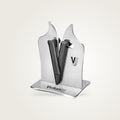
- VG2 Professional: a knife sharpener in solid stainless steel with replaceable sharpening elements, for plain edges and serrated blades in the same device.
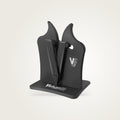
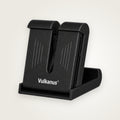
- Crown and Basic: the same sharpening mechanism in a compact housing, the Basic small enough for a pocket.
Read more
- Sharpening knives without a whetstone: what actually works
- Which sharpening angle for which knife?
- Professional knife sharpening or doing it yourself?
- Sharpening ceramic, Damascus and coated blades
- All guides and videos
In short
The honing steel realigns, the stone shapes, the pull-through sharpener holds the angle. Most people do not need the most precise tool, they need the one they will actually use.
See the VG2 Professional · Sharpening serrated knives · All guides and videos