
How often do I need to sharpen my knife?
The short answer: not by the calendar, by test. Any number someone gives you (“every three months”, “once a year”) is a guess. How long an edge lasts depends on your board, your steel and what you cut. Here are three checks that take thirty seconds together, and what really determines edge life.
The 30-second test
Do not rely on a single check. Run the ones that suit your knife:
- Paper. Hold a sheet freely in the air and cut into it. A sharp blade separates cleanly. A dull one crumples the paper or slides off.
- Tomato. Set the blade down, do not press, just draw it. Sharp means the skin gives way at once. Dull means the blade slides over the skin until you add pressure.
- Onion or cabbage. Does it crush instead of cutting? Do your eyes sting more than usual? Then the blade is tearing cells apart instead of separating them.
If the knife passes all three, leave it alone. If it fails one, three to five pulls are due.
What you should not do: run your thumb along the edge. It tells you little and regularly ends in blood.
What really determines edge life
The cutting board: the biggest factor
This is where most sharpness is destroyed, not in the cutting itself:
- Wood and soft plastic: good. The fibres give way.
- Glass, stone, ceramic, marble: the fastest route to a dull blade. Every contact is metal against something harder. A knife that meets glass daily is blunt within two weeks.
- The dinner plate. Cutting on a plate destroys in ten seconds what you built up before.
The steel
Hard steel (Japanese blades, good Damascus knives) holds its edge longer but chips more easily. Softer European steel dulls faster but can also be brought back faster. Neither is a verdict on quality; it is a design choice.
What you cut
Pumpkin, bone, frozen food and anything with sand or soil on it stress the edge many times more than vegetables and meat. Bread is gentler than its reputation suggests, the crust hardly wears the serrations, and a serrated edge lasts a long time.
The dishwasher
Heat, detergent and knocking against other items. Wash knives by hand and dry them at once. That extends edge life more than any sharpening.
Guide values, if you still want a number
- Normal household, wooden board: a short touch-up every four to eight weeks.
- Cooking daily, lots of vegetables: every one to two weeks.
- Restaurant, butcher: daily or several times a day, there, resharpening is part of the work, not an event.
- Bread knife: rarely, often only once or twice a year. It never meets the board.
- Hunting and fishing: in between, during the work. More on the page sharpening hunting and outdoor knives.
Why little and often beats rarely and long
An edge does not disappear suddenly. First it rolls over, then it wears away. Touch it up early and you are only realigning it, three pulls, done. Wait until nothing works any more and you have to remove material: longer, more wear, and over the years the knife gets narrower.
That is also why our knife sharpeners are built the way they are: three to five pulls, no water, no stone, no preparation. If resharpening takes ten seconds, people do it. If it is a skill, they put it off, and cut with a dull knife for half a year.
Frequently asked questions
Can I wear a knife out by sharpening it too often?
In theory yes, in practice hardly. A short touch-up removes very little material. Knives get narrow when they are worked on coarse stones for decades, not from a few pulls a month.
Is a honing steel in between enough?
A honing steel realigns a rolled edge but removes almost no material. It stretches the interval between two sharpenings, it does not replace them. On a serrated edge it does more harm than good.
My knife is new and cuts badly: why?
Not every blade leaves the factory sharp. On cheaper knives in particular the factory grind is coarse. Sharpen it properly once, after that touching up is enough.
Matching devices
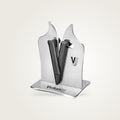
- VG2 Professional: a knife sharpener in solid stainless steel, replaceable sharpening elements, for plain edges and serrated blades in the same device.
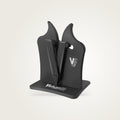
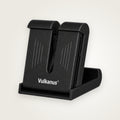
- Crown and Basic: the same sharpening mechanism in a compact housing.
Read more
- Is my knife blunt? Three tests in ten seconds
- Why do knives go blunt? The four real causes
- Which sharpening angle for which knife?
- Replacing sharpening elements: when is a knife sharpener worn out?
- All guides and videos
In short
Stop trying to remember a date. Run the paper test when something feels off, and if it fails, take ten seconds.
See the VG2 Professional · Which sharpening angle? · All guides and videos