
Sharpening hunting and outdoor knives: in the field too
A blunt knife in the field is not just annoying: it is dangerous. It slips instead of cutting, usually exactly when your hands are wet, cold and bloody and you start forcing it. The most common cut while field dressing does not happen with the sharp knife, it happens with the dull one.
Why hunting and fishing knives dull faster
A kitchen blade meets vegetables and a wooden board. A hunting blade meets:
- Bone and cartilage, every contact rolls the fine edge over.
- Hide and fur with sand and soil in it. That is the real killer: mineral particles act like sandpaper on the edge.
- Fish scales and bones when filleting, plus constant moisture.
That is why a hunting blade rarely lasts through a whole animal. Anyone who only resharpens at home works most of the time with an edge that no longer really separates.
Which angle suits outdoor blades
Kitchen knives are ground fine, outdoor blades deliberately more robust: hunting, fishing and pocket knives roughly 20–25° per side.
Grinding a hunting knife to a Japanese 12° looks impressive and chips on the first rib. There is more on the page Which sharpening angle for which knife?
The problem with sharpening outdoors
Out in the field almost nothing works the way it does at home:
- Water stones need water, a flat surface and steady hands. You have none of that in a hunting stand.
- A honing steel only realigns, it does not sharpen, and on a saw edge it does damage.
- Freehand on a stone demands a constant angle over thirty pulls. With numb fingers at dusk that will not happen.
What you need is a pocket-sized knife sharpener that works without water and holds the angle for you.
How to sharpen in the field
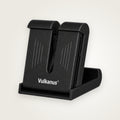
The Vulkanus Basic is built for exactly this: 80 grams, folding down to 19 millimetres, with a ring for your belt, pack or a cord. It sharpens straight blades and serrations.
- Pull through horizontally. That sharpens. Unlike the bench devices, the Basic sets the angle through its own shape, because it sits at a slant.
- To hone, turn the device over and pull through horizontally again.
Three to five pulls per step. No water, no oil, no surface needed. The sharpening elements are 93 HRC, harder than any steel blade you are carrying, and they leave neither heat nor a scratch on the steel.
What about the saw edge on the spine?
Many hunting knives carry a saw or serrated section on the spine. That is exactly where stones and steels fail, because they only reach the points. How to handle it is on the page sharpening serrated knives.
At home: the thorough pass
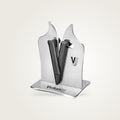
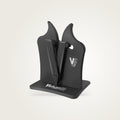
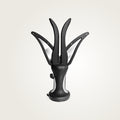
After the field the blade deserves one proper session. That is what the bench-top knife sharpeners are for: VG2 Professional, VG2 Classic or Crown:
- Tip tilted down = sharpening, removes material.
- Tip tilted up = honing, takes off the burr.
- Horizontal, back and forth = polishing.
Care that does more than any sharpening
- Clean and dry it immediately. Blood and game are acidic, wet and cold do the rest. Rust pits on the edge never fully come out again.
- Oil it thinly before the knife goes back into the sheath, especially with leather sheaths, which hold moisture.
- Often and briefly beats rarely and long. An edge that never goes fully dull is back in seconds.
Frequently asked questions
Can I sharpen my hatchet or axe with it?
No. Our safety information explicitly excludes axes, hatchets, scissors and tools. The sharpening elements are designed for knife blades, not for striking tools. For a hatchet or machete, stick to a file and a stone.
And fillet knives?
Thin, flexible blades do not like pressure. Pull them through gently, and rather one pull more than one too hard.
How often should I resharpen?
Once, partway through dressing a deer. It costs ten seconds and saves effort and risk. Then the thorough pass at home after every outing.
Does the sharpener itself rust?
The sharpening elements are made to be carried outdoors. Storing it dry is still better than storing it wet.
Matching devices
- Basic: the pocket knife sharpener for the field, 80 grams, folds flat, with a ring for belt or pack.
- VG2 Professional: the bench knife sharpener in solid stainless steel with replaceable sharpening elements, for the thorough pass at home.
- Crown: the same sharpening mechanism in a compact housing.
Read more
- Sharpening serrated knives and saw edges
- Which sharpening angle for which knife?
- Why do knives go blunt? The four real causes
- Replacing sharpening elements: when is a knife sharpener worn out?
- All guides and videos
In short
The blade goes dull in the field, so it has to get sharp in the field. A device that weighs 80 grams, holds the angle itself and needs no water is worth more out there than the best whetstone at home.
See the Vulkanus Basic · See the VG2 Professional · All guides and videos