
Professional Knife Sharpening or Doing It Yourself?
Both are right, just not for the same knives. The question is not which is better, but when each route pays off. Here is how to decide, including the cases where we send you to a specialist ourselves.
When a specialist is the better choice
There are cases no household knife sharpener can fix, and we say so openly, even though we build sharpeners ourselves:
- The edge has chips. When material is missing, the blade has to be rebuilt. That is grinding work on a stone or belt, not resharpening.
- The blade is warped or bent. That gets straightened before any sharpening happens.
- Ceramic knives. They are harder than most sharpening elements. Send them to the maker.
- Scissors, axes, tools. Different geometry, different equipment.
- A special knife. You do not put an expensive single-bevel Japanese knife through a pull-through device. That is about more than sharpness.
When a specialist is not worth it
For everyday use the trip to the sharpener rarely pays, not because of the price, but because of the time:
- Your knife is gone when you need it. Drop off, wait, collect. Meanwhile you cook with the blunt spare.
- You sharpen too rarely. Anyone who only takes a knife in once it is properly dull has been cutting badly for months. An edge that never goes fully dull is back in seconds.
- It never covers all the knives. People take the chef's knife. The bread knife, the steak knives and the little paring knife stay blunt in the drawer.
That is the real difference: sharpening yourself does not mean "thoroughly once a year", it means three passes before you start cooking.
The honest decision guide
- Five to ten kitchen knives and you cook regularly? Do it yourself. After a few weeks you will not want it any other way.
- One single very expensive knife? A specialist, or a whetstone and the patience to learn it.
- Twenty knives and little time? Do it yourself, no discussion. Nobody carts twenty knives across town twice.
- You enjoy craft and take pleasure in it? Then the whetstone is right for you. It can do more, but it demands practice and time.
The case against learning on a stone, and the case for it
The whetstone is the most versatile tool. It can remove chips, change geometries, handle any blade. In return you have to hold the angle by hand, across the whole length, on both sides. That is practice, not a trick.
Anyone who can do it needs nothing else. Anyone who cannot and does not want to learn will round the edge off, and that is worse than not sharpening at all.
More on this: Whetstone, honing steel or pull-through device
Our middle way
Since 1985 we have built knife sharpeners for the third type of cook: you want sharp knives, but you do not want to learn how to sharpen them.
The sharpening elements set the angle by themselves, between 11° and 21°. You hold nothing, you measure nothing. Three to five calm passes, no pressure.
And they do one thing no whetstone and no roller sharpener can: sharpening serrated edges, bread knives, steak knives, saw edges, in the same pass.
What it cannot do
No ceramic knives, no scissors, no axes. And it will not rebuild a blade with real chips, for that you need a specialist. We would rather write that down than disappoint you.
Common questions
Does a pull-through device ruin the knife?
Cheap ones with rigid carbide blades can: they tear material out instead of grinding it. What matters is whether the device adapts to the blade or forces its own angle on it.
How often should I sharpen?
Rather often and briefly than rarely and at length. Details under How often to sharpen a knife.
Can I do both?
That is actually the best route. Once a year to a specialist for the groundwork, and resharpen yourself in between. Then your knife is never blunt and the blade keeps its shape.
Matching devices
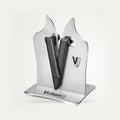
- VG2 Professional: a knife sharpener in solid stainless steel with replaceable sharpening elements, for plain edges and serrated blades in the same device.
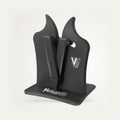
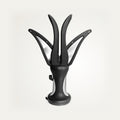
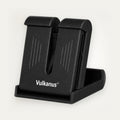
- Crown and Basic: the same sharpening mechanism in a compact housing.
Read more
- Whetstone, honing steel or pull-through sharpener?
- Sharpening knives without a whetstone
- How often do I need to sharpen my knife?
- Sharpening ceramic, Damascus and coated blades
- All guides and videos
In short
Damaged blades, ceramic and special pieces belong with a specialist. Everything else you sharpen yourself, not because it is cheaper, but because the knife is then sharp when you need it.