
Sharpening Steak Knives: Straight, Serrated and Micro-Serrated
Steak knives are the most neglected knives in the house. They come to the table a few times a year, usually when guests are over, and that is exactly when everyone saws away at their meat. It does not have to be that way.
First: which steak knife do you have?
There are three types and they are treated differently. Look at the edge in the light:
- A straight edge. One continuous line, no pattern. Sharpened like a chef's knife.
- A coarse serration. Clearly visible arcs, like a bread knife but smaller.
- Micro-serration. Looks almost straight but feels rough against a fingernail. Very common on shop-bought sets.
Micro-serration is the most frequent case, and the reason so many steak knives are considered "unsharpenable". They can be sharpened, just not with a whetstone.
Why stones and honing steels fail here
On serrated and micro-serrated edges the sharpness sits in the arcs, not on a straight line. A whetstone works across a flat surface: it cannot reach the arcs, it rounds off the tips.
The result is a knife that neither saws nor cuts properly. A honing steel is worse still: it only touches the tips.
That is why many guides say "do not sharpen serrated edges". What they should say is: not with these tools.
How to sharpen all three types
Straight steak knives
Like a chef's knife. Point down, pull through, three to five passes. Then point up to hone.
Serrated and micro-serrated
- Determine the direction. Look at the blade from above. If the serration is on the right-hand side, the point faces right.
- Insert from behind, from the handle, not from the tip.
- Pull through horizontally, with light sideways pressure towards the serration.
That sharpens and hones in the same stroke. No second round, no strop. Our knife sharpeners adjust to the angle of the blade by themselves, between 11° and 21°.
In detail, for all models: Sharpening serrated knives
Why steak knives last so long, and then suddenly do not
A steak knife barely touches a cutting board. It cuts on the plate, usually porcelain, and that is the point.
Porcelain is hard. Every cut that ends on the plate compresses the edge. On a knife that is rarely used this goes unnoticed for years. Then it gives out within a few meals.
If you change one thing: do not cut right down to the plate, stop the cut just short of it.
Before the big meal: the five-minute ritual
Six steak knives, three to five passes each. That is under five minutes, and it is the difference between guests who eat and guests who saw.
Take these along while you are at it: the bread knife and the carving knife. Both come out on the same days and are usually in the same state.
Common questions
Is it worth it on cheap steak knives?
Yes. Soft steel goes blunt faster but also sharpens faster. A twenty-euro set that gets touched up regularly cuts better than an expensive one that has sat in a drawer for five years.
Mine has a serration that tapers to a point. Does that work too?
Yes, as long as it is an edge and not a saw blade. What matters is the direction: the serration determines which side you insert from.
And carving knives?
Usually straight, so like a chef's knife. If it has a saw edge, as above.
Can I put them in the dishwasher?
Better not. They knock against other cutlery in the basket, and the fine serration is exactly what suffers. More on this: Why knives go blunt
Matching devices
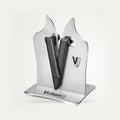
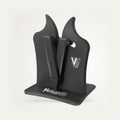
- VG2 Professional: a knife sharpener in solid stainless steel, for straight, serrated and micro-serrated edges in the same device.
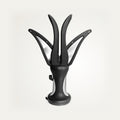
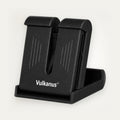
- Crown and Basic: the same sharpening mechanism in a compact housing.
Read more
- Sharpening serrated knives, bread knives and saw edges
- Is my knife blunt? Three tests in ten seconds
- Why do knives go blunt? The four real causes
- Which sharpening angle for which knife?
- All guides and videos
In short
Steak knives can be sharpened, micro-serrated ones included, just not with a stone or a honing steel. Five minutes before the meal and nobody saws.